AUC Home page
Back to AUC Home

AUC School of Business hosts AACSB info session for business schools across the region

Nouran Rabie
September 27, 2022
AACSB Info Session Story

On September 25, The Association to Advance Collegiate Schools of Business (AACSB International) and its member AUC School of Business hosted an Information Session for regional business schools on the value of the AACSB International Membership and Accreditation.

The interactive session focused on the business education landscape in Africa. The event featured Sherif Kamel, dean, AUC School of Business, Jonathan Foster Pedley, dean and director, Henley Business School Africa, and AABS board chairman, Tim Mescon, executive vice president and chief officer EMEA, AACSB International, and Ihsan Zakri, regional head, Middle East and Africa, AACSB International.

AACSB International is the world’s largest business education network connecting students, academia, and business to advance business education worldwide. It offers the world’s most widely recognized and sought-after endorsement for business programs, which the School acquired for the first time in 2006.

“We only accredit less than five percent of business schools around the world, so it is very exclusive,” underlined Tim Mescon during the information session.

"We have been in the AACSB cycle for the last 19 years, it is a journey not a destination. The process of accreditation really gets us to challenge ourselves taking the School to the next level by helping us remain relevant, timely, ambitious and future-oriented,” highlighted Dean Kamel.

The accreditation is a stamp for all stakeholders that the accredited school produces graduates who are prepared to succeed in the business world.

“It is not about being the biggest school, it is about being the quickest. What matters for business schools is not size, but agility to respond to the constant change in the world,“ explained Mescon.

The session explained how a business school’s effort in student engagement, its constantly updated curricula, its societal impact and how that is reflected in its research, as well as its mission statement, among other criteria, are how schools are measured by AACSB.

“There are really good business schools around Egypt, Africa and the rest of the world and they rarely come together. Education is so important to the growth of nations, and having an open discussion like that of today is what makes quality education,” stressed Jonathan Foster Pedley.

The session included more than 20 representatives from eight universities and two entities, namely AABS and AACSB. The participants had the chance to discuss their inquiries and concerns regarding the accreditation, its requirements and its procedures.

Mescon stressed on the need for professors to change their teaching methodologies. “Learning is much different today, and engagement is crucial for professors to grab and retain the attention of Generation Z students,” he stated.

“Human capital is the most important asset. If I had a button I would push investment in quality education,” expressed Dean Kamel, adding: “We need to push the ceiling to continuously improve or else we will not be resilient or agile.”

“Business schools should focus on how they can contribute to people’s growth, so they can run businesses better and lift the economies of their countries,” emphasized Foster Pedley. “We have to serve the young people and the executives and help make their lives better and we take that very seriously. It is not about us, it’s about them and the future,” he concluded.

This session fosters the School’s pioneering position in advocating for quality business education not only in Egypt, but within the entire region. It is an initiative, like many of the School’s, that aims to spread awareness about educational best practices within the community.

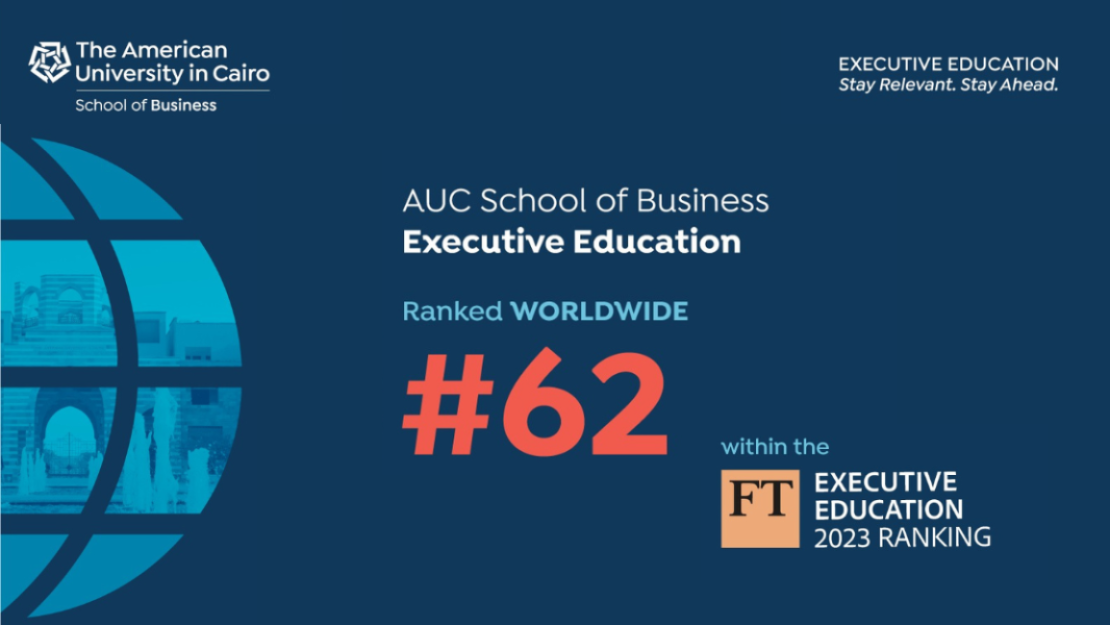
Find out more about AUC School of Business’ accreditations and rankings here.

Share

Celebrating 25 Years of Professor Nagla Rizk at AUC School of Business

A2k4d
Nouran Rabie
September 14, 2022

“Why we are here today is why AUC has been for the last 100 years making all the difference.” – Dean Sherif Kamel.

Student, teaching assistant, research fellow, faculty, department chair, center director and associate dean; Nagla Rizk has worn all the hats there are at AUC School of Business.


The professor of economics and founding director of the Access to Knowledge for Development Center (A2K4D) has been part of the School since 1979, where she started her journey as an economics undergraduate student.


“I am proud to be a member of this institution because of people like you. You have given the institution a lot, so thank you for everything,” expressed AUC President Ahmad Dallal.


“I used to visit the AUC Tahrir Campus with my mother, the late Professor of Sociology Madiha El-Safty, as a child, way before enrolling at the university,” said Rizk at the celebration of her silver jubilee on September 13. “I started very young at the  School and I am proud to have been part of its history,” she shared.


“Professor Rizk ticked all the boxes over her tenure at AUC School of Business,” said Dean Kamel, highlighting how she has always been adapting to global changes in education.


Indeed, Rizk has developed and introduced multiple courses to the School’s Economics curriculum such as “The Digital Economy, Information Technology and Economics”, “Undergraduate Econometrics”, and “CopyrightX: The Economics of Copyright and Creativity”, which is a Harvard course, where students receive a certificate from Harvard University.


“I have been visiting the AUC Tahrir Campus since I was a child in 1970. The Department of Economics has been my home since a very young age,” expressed Rizk, adding: “Even when I went to Canada for my PhD, I still kept close contacts with the department.”


Rizk shared her feelings about being celebrated by the School: “I am grateful and honored. I feel at home.” She added: “As the Department of Economics celebrates its 75th anniversary, I am proud to have been an active part of one third of its history, and to have studied and worked with an incredible community of people including icons like Professors Adel Beshai, William Mikhail and Galal Amin. I have learned from each and everyone I engaged with throughout this journey.”


These heartfelt comments were followed by her plans for the next 25 years: “I am just going to continue doing what I am doing – work hard, maintain  high standards, explore  new ventures, ensure constant development and give back to the department and the School through my teaching, research and service.”


When asked about A2K4D, Rizk explained that the center was born out of her “firm belief in the role of knowledge and technology for the betterment of human lives in the context of a dynamic world powered by the internet and fast-evolving digital technologies, and the complex implications of all this for developing countries in particular.”


“We should be at the forefront of issues happening worldwide,” she explained. “Our role as Egyptians, Arabs and Africans is to bring the voice of our part of the world to inform global conversations on these issues, not as observers but as active contributors to shaping the narrative,” she stressed, demonstrating how the center has partners in various parts of the globe to help fulfill this purpose.


“This is what A2K4D is about,” she stated.


Rizk emphasized the link between research and teaching, and that teaching should draw on theoretical underpinnings to tackle timely issues and explore current contexts through practical examples that students can relate to.


Nagla Rizk has been and will continue to play a vital role in the development of AUC School of Business, whether through her academic contributions – her teaching and research – or through her internationalization and outreach efforts, where she was able to secure over three million dollars in grants and gifts to support research at A2K4D and the School. Furthermore, Rizk has represented the School in multiple fora around the world, and hence, helped expand our reach on the global stage, especially in the realms of access to knowledge, intellectual property, innovation, technology, the future of work and gender.


Thank you, Professor Rizk, and to many more years to come!

Share